



SAFFRONThere is good news and less good news this year. With the high pricing of the last two seasons, more farmers have gone back to growing saffron on the La Mancha Plateau and other producing regions in the world, and prices have been coming down. The largest drop in prices is for Persian Saffron, where an enormous crop was produced. Alas, the U.S. reinstated a trade embargo against Iran in late September 2010 that precludes the importation of their Saffron. However, I do have a pleasing new stock of very strong saffron from Northwestern Greece, and of course the dependably beautiful and aromatic Spanish Mancha Saffron at considerably better prices than last year.
VANILLA BEANS and EXTRACTS AND VANILLA BEANS IN GLASS TUBES
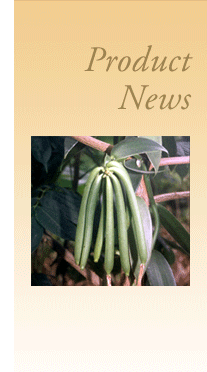
I have in stock an ample quantity of very beautiful oily' large beans, very high in vanillin content, and that have the most recognizable flavor profile. Luckily, pricing remains very attractive. despite the general rise in pricing of agrocomodity products around the world. I am still able to provide the highest quality gourmet beans that I insist on. Extract quality beans are available by special order at prices 40-50% less than the gourmet grades. I have recently added one and two fold extracts made from 100% Madagascar beans available in two retail sizes and two manufacturing /restaurant sizes. After visiting the vanilla growing region in Veracruz, Mexico, I became enamored of the vanilla grown there. It has a rich history and tradition: the Totonac Indians were flavoring their hot chocolate with vanilla before Cortez ever appeared. Veracruz and other parts of Central America emerged as the birthplace of all vanilla. The Totonacs, whose ancestors first learned how to cure the bean continue to do much of the growing and harvesting of this beautiful premium vanilla. These whitish yellow orchid flowers bloom in the spring, when intensive work of hand pollination begins. The green vanilla beans typically remain on the vine until an early December harvest. The beans are then subject to hot water or oven heat, after which for the next several months they are laid out in the midday sun for several hours and are then brought inside, covered over, and allowed to 'sweat'. This process continues for 45-90 days, although some of the beans that I buy are sun cured for up to five months before export. The result of the extended cure is a very rich oily vanilla pod, with complex flavors and high vanillin. This variety of vanilla from Veracruz is called Planifolia 'Andrews' and is the variety now grown in Madagascar, Indonesia, and Uganda. This variety evolved from various cuttings taken from one or more of these Central American areas and thence to Europe and on to various tropical areas around the world. A second variety grown only in Veracruz is called Pompona, a bean famous for its intense aroma, and which i should have available soon. Though the history of vanilla types is quite vague, it is thought likely that the 'Tahitensis' beans now grown in Tahiti are a hybrid blend of these two types found in Veracruz. I have available beans richly flavored beans subjected to both the traditional and also the extended curing times. Also available are varying lengths and number of beans per pound. * I am also pleased to have in stock a beautifully complex Veracruz Vanilla Extract. Hopefully a new line of strictly organic vanilla beans and extract will be introduced soon. Prices of vanilla harvested in Tahiti are finally trending downward, but are still well above the broader market. Hopefully this down trend will continue, as a result of the French Polynesians reacting to the market share they are losing to the 'tahitensis' varieties being produced in Papau New Guinea. My current inventory from Tahiti consists of the large 'oily' highly aromatic crop that has given Tahitian vanilla its worldwide reputation. I have a good inventory of 'tahitensis' vanilla from Papua New Guinea that shares much of the heliotropin aroma of the Tahitian grown beans, and that also have excellent vanillin content that exceeds that found in Tahitian beans. I have added a new PNG 'Tahitensis' Vanilla Extract. However, I have not been able to get a shipment of the 'Planifolia' beans from Papua that meet my standards. Please inquire about when a new shipment might arrive. Please inquire if you are interested in vanilla from these regions, which is occasionally available. I have recently found a good source from Madagascar, will soon introduce organically grown beans from Veracruz, and am investigating other origins. Please feel free to inquire about special orders. Extract grade vanilla beans are available by special order and are subject to a 25 pound minimum order. These beans, whose origins may be Madagascar, Papua New Guinea or Indonesia, have a lower moisture content. However, they can sometimes be provided at less than half the price of the prime and gourmet grades, except when there are widespread shortages. Abundant supplies appear to be available this year. Please call or email. It will be a pleasure to speak with you about products and trade conditions. Buddy Born Bacstrom Import Company |
